Structures

Design & Technology

Research

Quality

Safety

Design Exercises

Resistant Materials

Measuring, Marking Out And Setting Up

Materials Processing
Assembling Parts
Transporting

Industrial Production

Mechanisms

Structures

Energy

Moral, Cultural, Envir.

Terms & Conditions

Contact Us

Record of Exercises
CD content mapped against AQA, WJEC, OCR and Edexcel specifications  
Place an
on-line order
 

Notes About Structures

This section in the full version Design and Resistant Materials Technology package, contains notes about structures, including:


  • Frame structures
  • Shell structures
  • Loads
  • Forces
  • Struts
  • Ties
  • Beams
  • Structural sections
  • Bridge types animation
  • Design exercises

Frame Structures

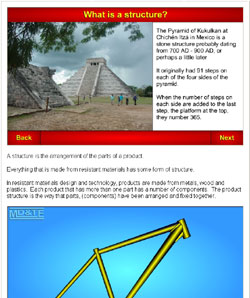
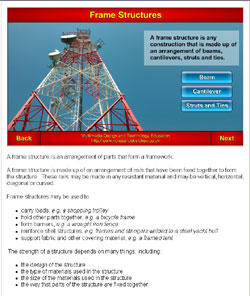
A frame structure has a framework of parts that are usually held together in a way that forms a rigid structure. The strength of the structure, i.e. the amount that the structure can withstand loads and forces is determined by the types of materials in the frame structure, the shape and size of the materials in the frame structure and the way that the parts are arranged and fixed together. 

Shell Structures 

A shell structure has a skin of material that gives the structure its form and strength. The strength of the structure, i.e. the amount that the structure can withstand loads and forces is determined by the types of materials used in the shell structure, the shape and thickness of the shell structure and the way that additional parts that are attached to the shell structure are arranged and fixed to it. 

Frame structure made of welded steel.

Frame structure of a steel steel yacht receiving its hull plating.

Frame structure of a yacht trailer.


Structures Design Exercises

This section contains design exercises set in a structures context,  including:

Framed Structures: A Shop Front Awning

An awning is a shelter made of fabric. The fabric for an awning is usually supported on a frame that is attached to another structure such as a building or a caravan. A shop front awning usually covers an area of pavement where people pass the shop. A shop front awning must not obstruct pedestrians in any way.


Design Brief:  
Design a frame that can support a fabric awning. 

Specification:  
The awning should shelter a shop-front and should cover an area of 4 metres long by 
2 metres wide. The frame should be a permanent structure that is fixed to the shop-front. Pedestrians should not be obstructed by any part of the awning. The front edge of the awning should be supported by a rail 2.2 metres high whilst the back edge of the awning should be supported by a rail 3.2 metres high.

Frame structure design exercise.


Use notes and sketches to illustrate:
  1. a side view of the awning;
  2. how the back rail could be attached to the shop front;
  3. how the front rail could be held in position 2 metres from the shop front and 2.2 metres high;
  4. a design for a frame structure that can support the awning;
  5. details of the material that the structure could be made from;
  6. details of how parts of the structure could be fixed together;
  7. details of the finish that could be applied to the structure and give reasons for your choice.

    Draw an illustration of your design for the awning with the fabric in place, taking into account the effect that your frame will have on the shape of the awning. 

Home

Multimedia Design And Technology Education
www.NotesAndSketches.co.uk
info@notesandsketches.co.uk

Multimedia Design and Technology Education - http://www.notesandsketches.co.uk

© Multimedia Design and Technology Education