Shape

Shapes are often the first thing that we notice about a design.  Shapes can make a design look beautiful or they can make it look plain.  Shapes are very important in design and can make the difference between parts of a product fitting together or not fitting, working properly or not working at all.

Shapes are two dimensional, i.e. a shape may have length and width or a diameter. Form is three dimensional, i.e. form has length, width and thickness.


Shape is one of a series of topics in the design basics section of our KS3 Design and Technology software.

Big discounts on all licences
 
Single User Licence
Site Licence
KS3 D&T
Was £45, now £30
Was £120, now £60
KS4 D&RMT
Was £45, now £30
Was £120, now £60
KS3 / KS4 D&T bundle
Was £65, now £40
Was £150, now £75

Click on a link below, fill in an order form,
then download our D&T software

Pay using a Credit Card
Invoice my school / college


Shapes of lines

Lines may be described as having a particular shape, e.g. a helix or a spiral.  

Shapes between lines

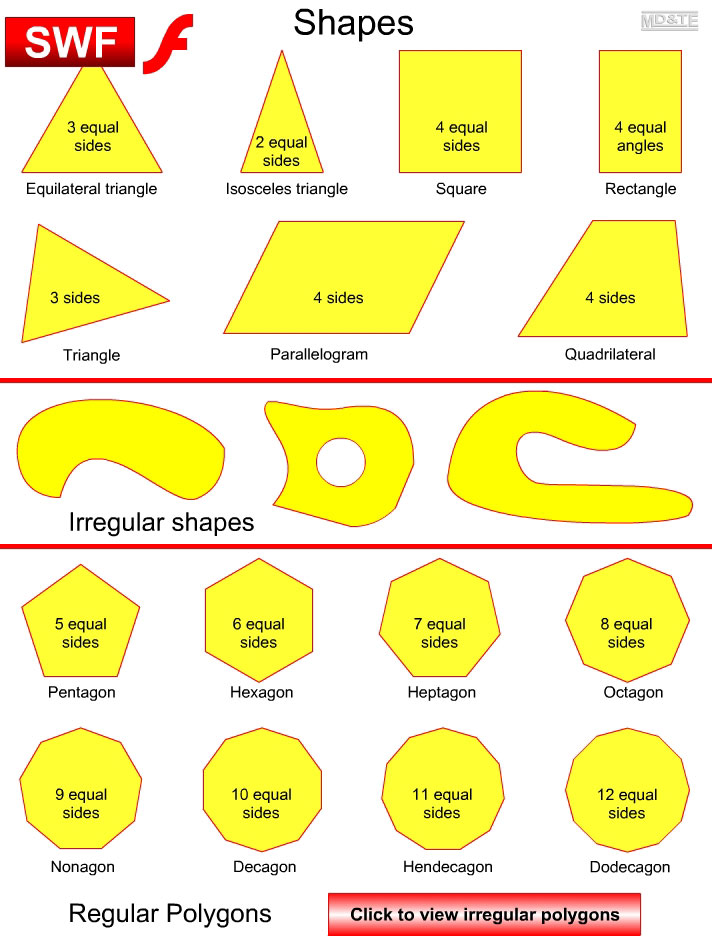
A shape may also be thought of as the space between a set of lines or curves, e.g. the square and the other shapes illustrated below.

Diagram of a spiral and helix
 

A polygon is a shape that has three or more straight sides.

A regular polygon has sides of equal length and equal angles between the sides.  

For example, the pentagon below does not have sides of equal length or equal internal angles, therefore it is simply a pentagon, not a regular pentagon.

Shapes within curved lines include the circle, ellipse or oval and irregular curved shapes.

 
Curved shapes
 
Shapes can be used to create mechanisms such as cams, gears and sprockets.  These mechanisms transmit forces and convert one type of motion into another type of motion.


Use the back arrow in your browser to return to the page that you were viewing previously