 |
|||
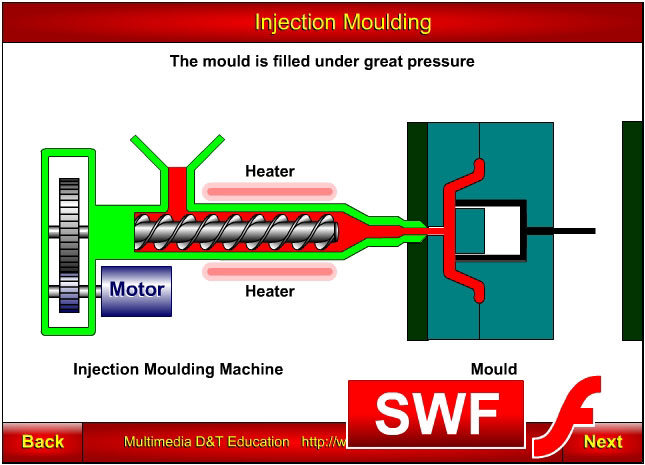
Click on the screenshot above to view the "Injection Moulding" animation by Laszlo Lipot |
|||
|
|||
IntroductionInjection moulding is a widely used process in manufacturing. It is a quick way of producing large numbers of identical components such as plastic trays and safety helmets. Most thermoplastics can be injection moulded, including,
The injection moulding processPolymer pellets are fed into the hopper of the injection moulding machine. The pellets pass to the heated barrel of the injection moulding machine where they melt. The feed screw rams the molten polymer into the mould under great pressure. When the plastic component in the mould has cooled and solidified sufficiently, the mould is opened and the component is ejected. CLEAPSSPlease refer to CLEAPSS, Model Risk Assessments for Design and Technology in Secondary Schools and Colleges, Part 1.058 COSHH Regulations. |
|||
| Click here to view the PDF version of this resource. | 
|
 |
|

 to view the animation in a new window.